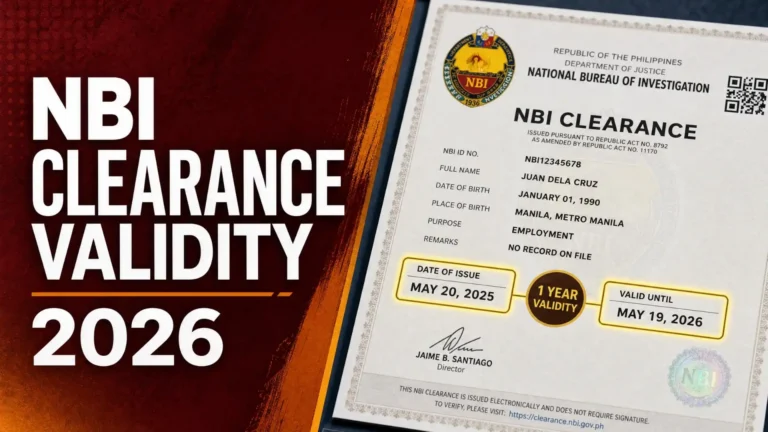
NBI Clearance Sample 2026: What It Looks Like
Just got your NBI Clearance, or about to apply? Here’s exactly what the document looks like, every field on it, the security features that prove it’s genuine, and what to check before you leave the releasing counter.
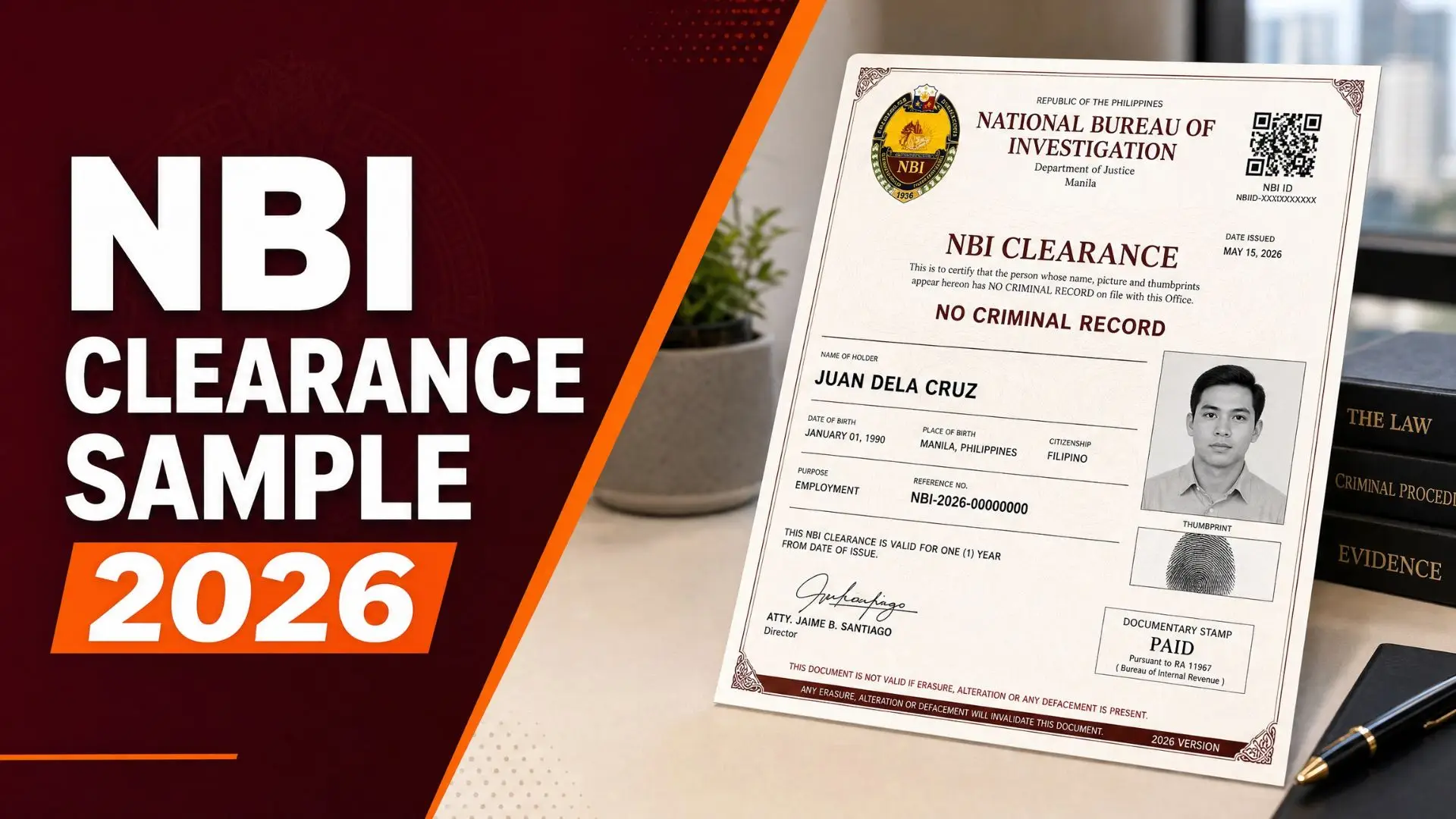
An NBI Clearance is a single machine-printed page headed Republic of the Philippines, Department of Justice, National Bureau of Investigation. It shows your photo, signature, full name, birth details, address, citizenship, civil status, gender and purpose, your result under Remarks (“NO DEROGATORY” if your record is clear, or a HIT), plus your NBI ID number, a QR code, a barcode and your right thumbmark. It’s valid for one year.
What an NBI Clearance Looks Like (Sample)
Here is what an NBI Clearance looks like. The labeled guide below shows exactly where each field, security feature, and the dry seal appear, so you can read your own clearance and check that every detail is correct before you leave the counter.

Labeled field guide showing the layout of a genuine NBI Clearance.
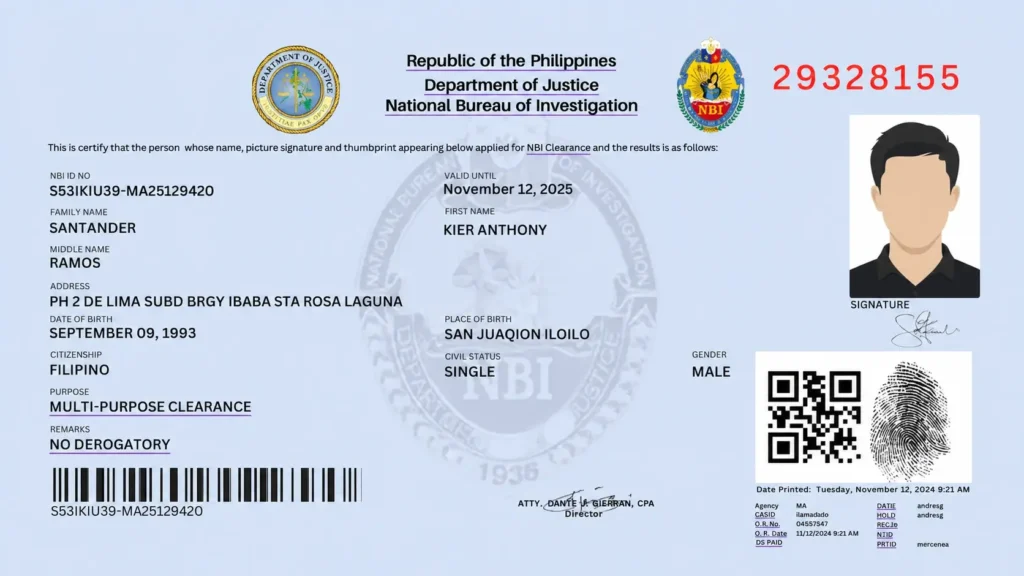
A real NBI Clearance with all personal details redacted for privacy. Yours will show your photo, name, result, reference number and QR code.
How to Read an NBI Clearance, Section by Section
A modern NBI Clearance is a single machine-printed page. Reading it top to bottom, here is exactly what you will find and what each part means.
Header and Reference Numbers
At the top, the Department of Justice seal sits on the left and the National Bureau of Investigation seal on the right, framing the title Republic of the Philippines — Department of Justice — National Bureau of Investigation. A line below certifies that the person whose name, picture, signature and thumbprint appear on the document applied for NBI Clearance, with the result shown.
There are two separate numbers, and it helps to know the difference:
- Clearance serial number — a bold number printed in red at the top right. It identifies this specific printout.
- NBI ID No. — a longer alphanumeric code (for example, a string of letters and digits) shown in the details area and repeated as the barcode at the bottom left. This is your record ID. Save it — you will use it for verification and future renewals.
Personal Details
The middle of the document lists your information under clear labels. On a genuine clearance every entry is machine-printed, never handwritten.
| Field | What it shows |
|---|---|
| NBI ID No. | Your unique alphanumeric record ID (also shown as the barcode) |
| Family Name / First Name / Middle Name | Your full name, split across three labels |
| Address | Your residential address as entered in your application |
| Date of Birth / Place of Birth | Your birth details |
| Citizenship | For example, Filipino |
| Civil Status / Gender | For example, Single / Male |
| Purpose | Why you applied — for example, Multi-Purpose Clearance |
| Remarks | NO DEROGATORY if your record is clear, or a HIT indication if your name matched a record |
| Valid Until | The expiry date — one year from issuance |
Photo, Signature, Thumbmark and QR Code
The right side carries your identity and the document’s verification tools:
| Element | What it is |
|---|---|
| Photo | The picture captured during your biometrics — you can’t substitute your own |
| Signature | Your signature, captured at the appointment |
| QR code | Scan it to confirm the clearance against the official NBI database |
| Right thumbmark | Your fingerprint impression |
| Barcode (bottom left) | Encodes your NBI ID number for quick lookup |
The Security Background
Look at the centre of the page and you will see a faint, printed NBI seal watermark with the year 1936 and the bureau name woven into the background. This printed security pattern, together with the machine printing, is part of what makes the document hard to copy convincingly. On the physical printout you may also feel an embossed dry seal — run a finger over it; a flat, printed-looking seal is a warning sign. These are classic security-printing features.
The Footer (Authority and Print Details)
At the bottom, the document shows the NBI Director’s printed name and facsimile signature in the centre (this changes depending on who holds the post), a Date Printed timestamp, and a small block of transaction codes such as Agency, O.R. No., and O.R. Date. Those codes are used internally by the NBI to track the transaction — you don’t need to do anything with them, but they’re normal to see on a genuine printout.
What “NO DEROGATORY” Means
This is the line you want under Remarks. It means the NBI database found no derogatory (criminal) record matching your details, so your clearance is complete and valid for one year. If instead it indicates a HIT, your name matched a record and needs verification — which is usually just a namesake. Our guide to HIT status explains exactly what to do.
How to Tell It’s Genuine
- Scan the QR code — it should open the official NBI portal showing your matching details and status. A code that won’t scan, or redirects elsewhere, is suspicious.
- Everything is machine-printed — a genuine clearance never has handwritten entries.
- The printed seal watermark with “1936” should be visible in the background.
- Embossed dry seal on the physical copy — raised and textured to the touch.
Don’t Laminate It
Lamination can damage the QR code and the security printing, and many employers and embassies reject a clearance whose QR no longer scans. Use a clear card sleeve or plastic envelope instead — it protects the document without harming the verification features.
Check These Before You Leave the Counter
Errors are easy to miss in the moment but cause real problems later. Same-day corrections are free; if you’ve already left, fixing them usually means a new application.
- Name — read it letter by letter against your ID, including middle name and suffix
- Date of birth — a single flipped digit causes mismatches
- Purpose — make sure it matches what the requesting party expects
- Photo, QR and seal — clear photo, a QR that scans, and the seal present
Once it checks out, you can confirm it yourself anytime — see our guide to verifying an NBI Clearance.
Frequently Asked Questions
Conclusion
Knowing what an NBI Clearance looks like helps you spot errors and fakes alike. Genuine ones are machine-printed on security paper with a photo, your details, the result, a reference number, an embossed dry seal, and a scannable QR code. Check your name and birth date before leaving the counter, skip the lamination, and you’ll have a clean, verifiable clearance ready to use.