NBI Clearance vs Police Clearance: What’s the Difference?
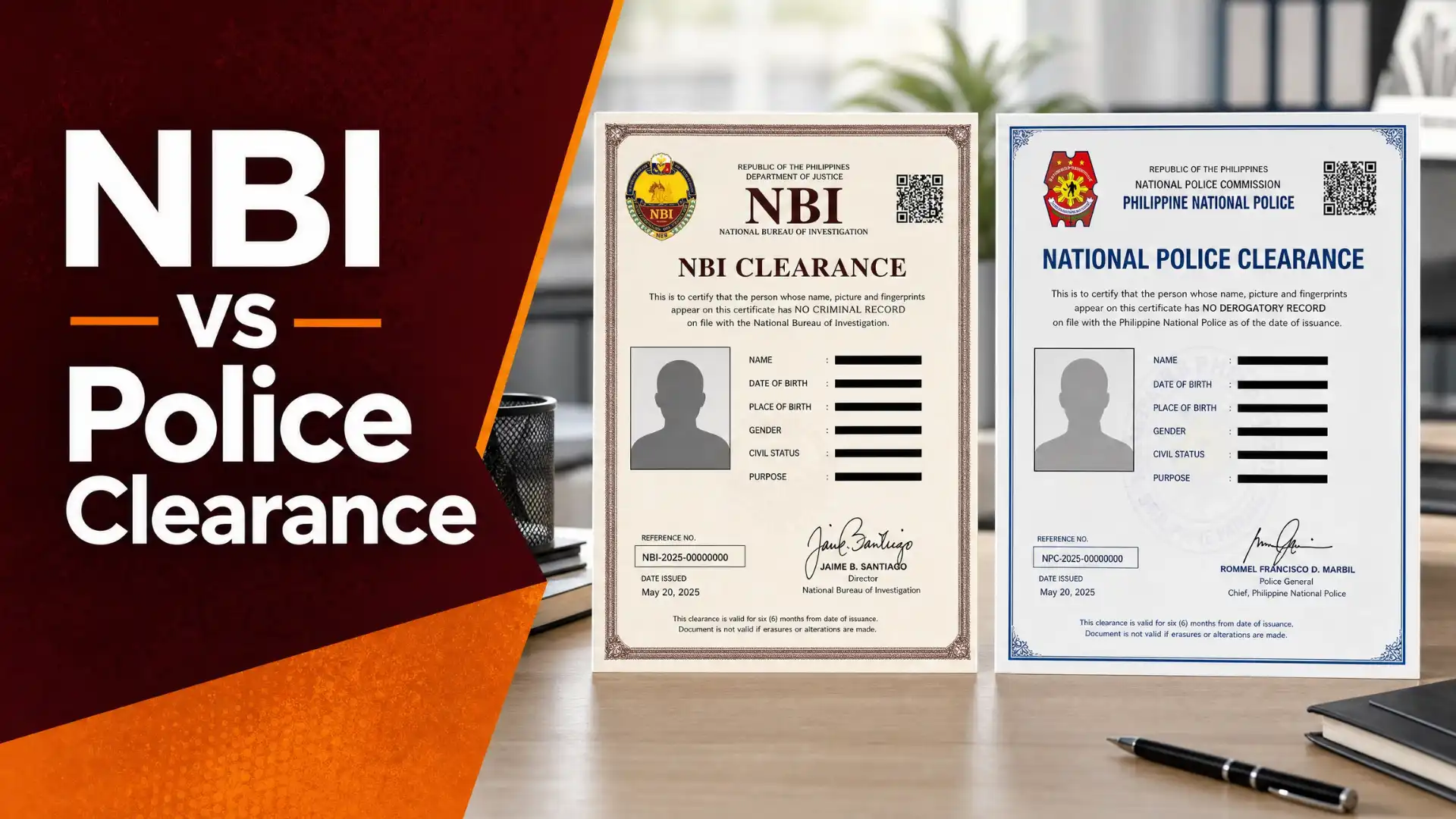
Both prove you have a clean record — but they’re issued by different agencies, check different databases, and last for different periods. Here’s how NBI Clearance and Police Clearance compare, and which one you actually need.
An NBI Clearance is issued by the National Bureau of Investigation, checks nationwide court and derogatory records, and is valid for one year — preferred for employment, visas, and overseas use. A Police Clearance is issued by the Philippine National Police; the modern National Police Clearance now also checks records nationwide and is valid for six months. NBI is broader and longer-lasting; police clearance is quick and often enough for local needs.
What Is an NBI Clearance?
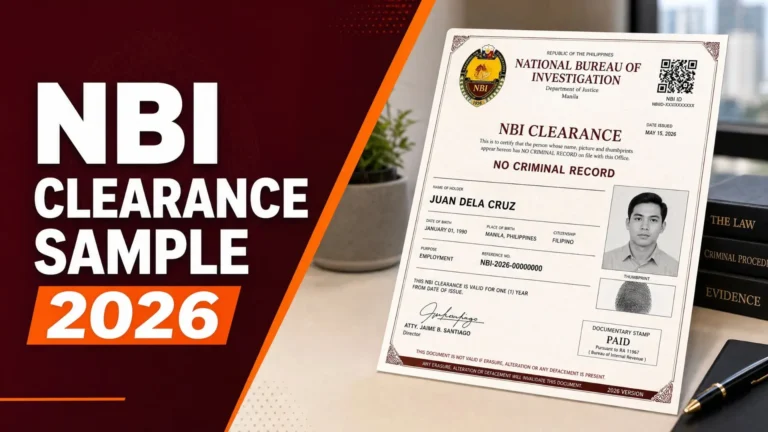
Issued by the National Bureau of Investigation (an agency under the Department of Justice), it certifies you have no criminal or derogatory record in the NBI database, which draws from courts and prosecution offices nationwide. It’s the document most employers, embassies, and agencies ask for, and it’s valid for one year.
What Is a Police Clearance?
Issued by the Philippine National Police (PNP), an agency under the Department of the Interior and Local Government, it certifies you have no record in the police database. Importantly, there are now two kinds:
- National Police Clearance (NPC) — applied for online through the National Police Clearance System and checked against the nationwide PNP database. This is the modern, widely accepted version.
- Local Police Clearance (LPC) — obtained at a local station and limited to that city or municipality. Often needs a barangay clearance.
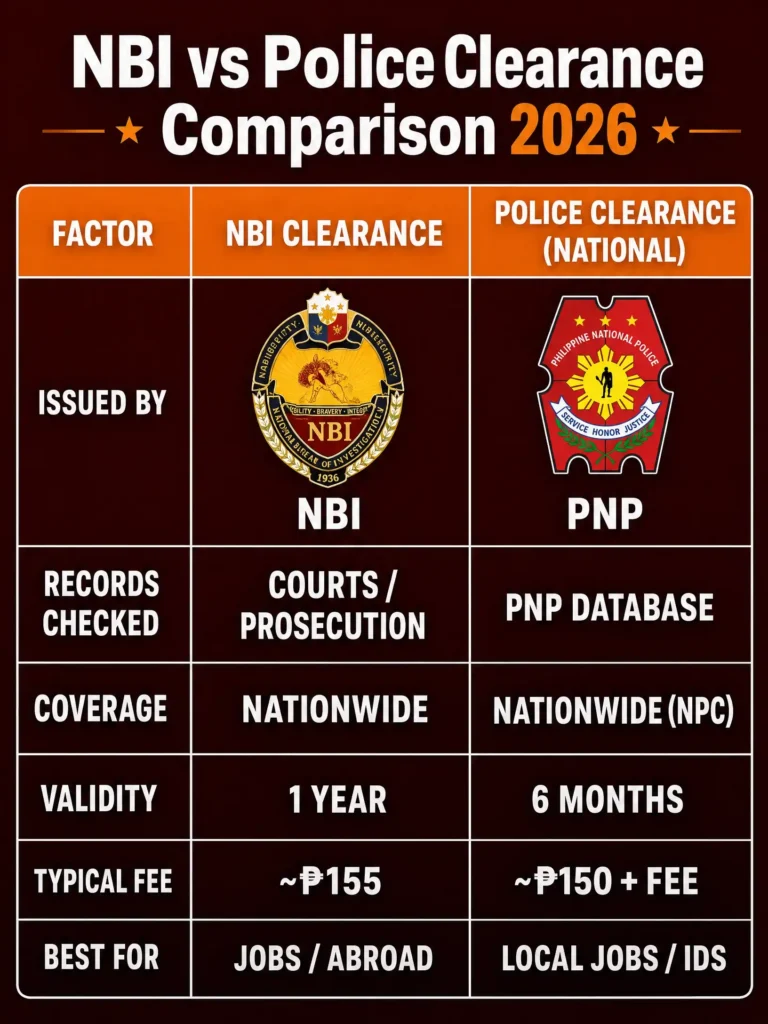
NBI vs Police Clearance: Side by Side
| Factor | NBI Clearance | Police Clearance (National) |
|---|---|---|
| Issued by | National Bureau of Investigation | Philippine National Police |
| Records checked | Courts & prosecution (derogatory records) | PNP police database |
| Coverage | Nationwide | Nationwide (NPC); local only (LPC) |
| Validity | 1 year | 6 months |
| Typical fee | ~₱155 | ~₱150 + service fee (₱160–180) |
| Process | Online register + appointment + biometrics | Online register + appointment + biometrics |
| Best for | Jobs, abroad, visas, immigration, government | Local jobs, gov’t IDs, firearm license, banks |
The Key Differences Explained
Issuing Authority & Database
The biggest difference is who checks what. A simple way to remember it: the police handle the arrest; the courts handle the trial. A police clearance reflects police records — blotter entries, complaints, and standing warrants — while an NBI Clearance reflects judicial records, meaning cases that actually reached the prosecutor or court. That’s why higher-stakes applications like visas and overseas work specifically ask for the NBI version.
Validity
NBI Clearance lasts one year; police clearance lasts six months. If you need a document that stays valid longer, NBI is the practical choice — see our guide to NBI Clearance validity for the details.
Coverage
NBI is nationwide by design. Police clearance used to be purely local, but the National Police Clearance now checks the nationwide PNP database too — so the old “police clearance is only local” rule no longer fully applies, unless you specifically get a Local Police Clearance.
Cost & Speed
Police clearance is often a touch cheaper and can release same-day after biometrics. NBI is similarly priced and often same-day too (without a HIT), but is accepted more widely for formal and international purposes.
When Should You Choose Each?
| Choose NBI Clearance for… | Choose Police Clearance for… |
|---|---|
| Employment with large companies or abroad | Local or small-scale job applications |
| Visa, passport & immigration processing | Government ID applications |
| Legal proceedings needing nationwide proof | Firearm license, bank, or local permits |
| Government positions & higher education | When an office specifically asks for police clearance |
Can NBI Clearance Replace Police Clearance?
Often, yes — because the NBI check is broader, it’s accepted in place of a police clearance for many purposes. But not always: some offices specifically require a police clearance (or even a Local Police Clearance), and some require both. For immigration in particular, the NBI Clearance is usually the document specifically named in the requirements, and a local police clearance may not be accepted. The safe move is always to confirm exactly which document the requesting party wants before you apply, so you don’t pay for the wrong one.
What They Have in Common
- Both prove you have no criminal record and are issued by the government.
- Both now use online registration + appointment, then in-person biometrics (fingerprints & photo).
- Both can return a “HIT” for a name match, needing extra verification.
- Both are free for qualified first-time job seekers under RA 11261.
How to Get Each
For the NBI Clearance, register and book on the official NBI portal, pay, and complete biometrics — our full NBI Clearance guide walks through every step. For the National Police Clearance, apply through the official National Police Clearance System and visit your chosen station for biometrics.
Frequently Asked Questions
Conclusion
NBI Clearance and Police Clearance both certify a clean record, but the NBI version is broader, lasts a full year, and is the go-to for employment, visas, and overseas use, while the National Police Clearance is a fast, nationwide option often sufficient for local and government needs. When in doubt, ask the requesting office which they need — then apply for the right one the first time.